
Jesus Dated All 27 N.T. Books
Did you know that there is internal evidence—found in the official Bible itself—which dates the exact year: for every single one of the 27 books, in the New Testament (NT)?
——————————————————————————————————————————————————————
The Sower: AD 30-100, Under the Radar
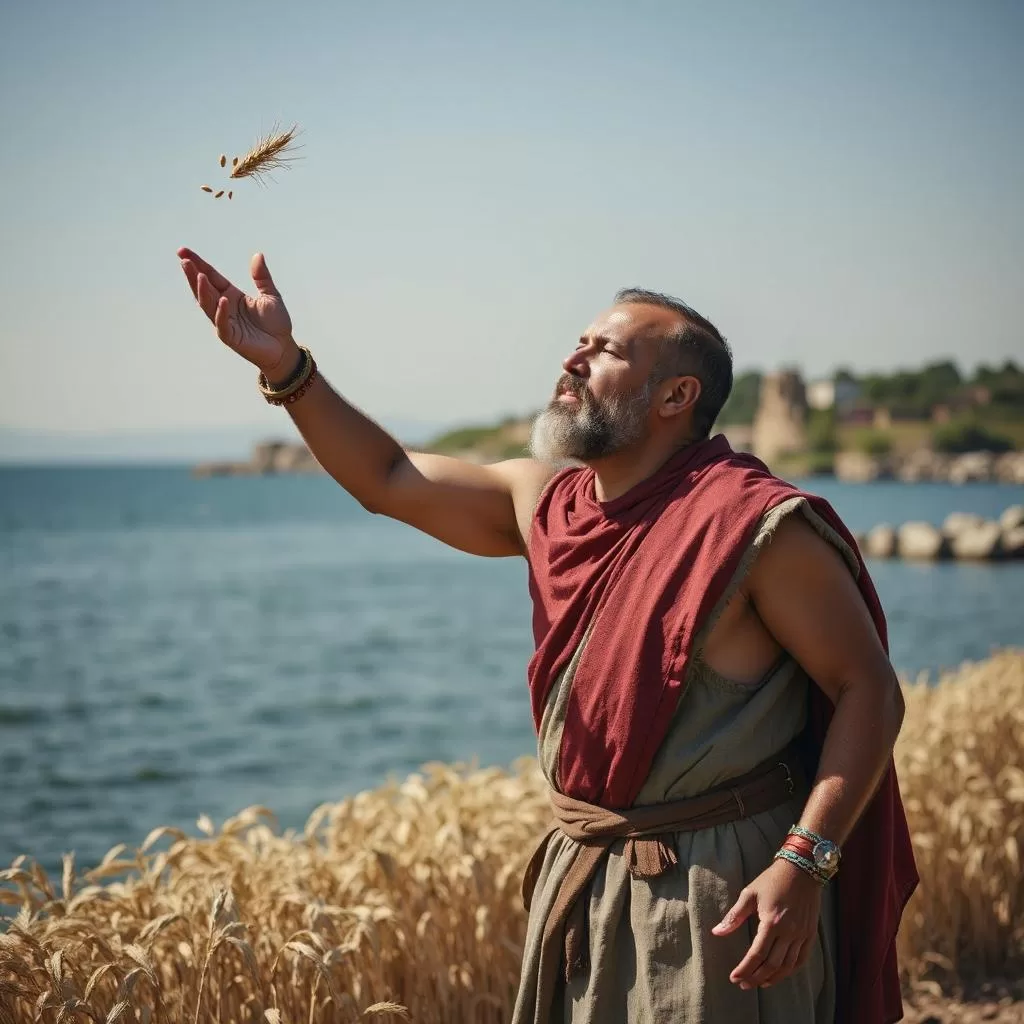
Jesus foresaw all of the Babel Skeptic attacks, on the Bible; so He carefully hid various truths, designed to thoroughly refute all of these attacks. Furthermore, Jesus was a master of saying things—that seem rather simple, or mundane (although true); but at the same time: He was also sending very important messages, under the radar. For example, the parable of the sower (quoted below); in this parable, Jesus Himself even applied this parable to His “WORD” (the word of God, the Bible).
Mark 4:8,20, “And other fell on good ground, and did yield fruit that sprang up and increased; and brought forth, some thirty, and some sixty, and some an hundred. … And these are they which are sown on good ground; such as hear the WORD [such as Matthew and John—who were present, and heard Jesus speak these words], and receive it, and bring forth fruit [such as the gospels, of Matthew and John], some thirtyfold, some sixty, and some an hundred.” (see Matthew 13:8,23).
Jesus mentioned 30, 60, and 100—are these just random numbers? Why did Jesus pick these numbers? Because all 27 of the NT books were written, between AD 30 and AD 100—all in the FIRST CENTURY; and almost all of the 27 books, were written in the 30s or 60s (see below).
——————————————————————————————————————————————————————
Overview of Years, for the 27 Books
Thirties: Matthew, Mark; James, Hebrews (4 books).
Fifties: First & Second Thessalonians; First & Second Corinthians (4 books).
Sixties: Romans, Galatians; Luke, Acts; Ephesians, Philippians, Colossians, Philemon; Titus; gospel of John; First & Second Timothy, First & Second Peter, First & Second & Third John, Jude (18 books—exactly 2/3 of the 27 total).
NOTE: There is a three decade gap—between these last NT books, and Revelation; this gap was planned by God, for extremely important reasons (details to come, later).
Nineties: Revelation (1 book, in AD 96); there is hidden prophecy, in Revelation itself, which gives the exact day for this book (similar to Song of Songs, see Part 1).
——————————————————————————————————————————————————————
Babel Skeptics Unmasked by Jesus
The above books are generally listed, in the sequence that they were written (in a few cases, there is some overlap). Yet to come, is a much longer study: documenting the exact year, that every NT book was completed (some were in the process of writing, during more than one year); this is mostly accomplished, through understanding exact dates of NT events (click here). Additionally, though, there are hidden checks, cross checks, and verifications, etc (including, but not limited to, the above parable).
Notice that the first two gospels were written in the 30s (Matthew and Mark); and the last two gospels were written in the 60s (Luke and John). Matthew and John were present: when Jesus told this sower parable, on the shores of Capernaum (on May 10, Julian calendar)—which is another clear indication, that Jesus was giving important chronological dates (for the gospels of Matthew and John, etc). Furthermore, this shows that these same two men were the authors, of these two gospels (debunking the Babel Skeptics, who are proud of their ignorance, and say that we just don’t know who wrote the gospels, etc).
So this sower parable has “under the radar” dating—which refutes the Babel Skeptic dates, for the gospels, which are usually around AD 70 or later; some even try to put NT books into the second century AD. But Christ’s AD 30 through AD 100 range, totally eliminates that unbiblical fantasy. Additionally, at the same time, Jesus unmasked full preterism—because His range ended in AD 100, not in AD 70!
——————————————————————————————————————————————————————
Mark Was NOT the First Gospel
Wikipedia: “The early patristic scholars regarded Matthew as the earliest of the gospels and placed it first in the canon …” (https://en.m.wikipedia.org/wiki/Gospel_of_Matthew).
Internal evidence is far more important, than patristic scholars; but in this case, all sources agree: Matthew was written FIRST! All agree, that is, except the Babel Skeptics, and those who have unfortunately followed their very flimsy lead. The four gospels were written in the same order, as they are located in standard Bibles: Matthew, Mark, Luke, John—so Matthew was written first, POSITIVELY NOT Mark!
The hand of God guided: not only the books of the sacred canon, but also the order of them (see Part 0, click here); this is just one of many internal evidences, that Matthew was written first. Also, the last book was written last—Revelation! This does not mean that all NT books were written, in the same order as they appear in the canon; sometimes, there are reasons for arrangement, other than the years written.
But Mark was not first; this LIE was designed for the very purpose of destroying the foundation of Christianity, the resurrection of Christ—and yet many Christians have unwittingly accepted it, not realizing the motive behind it. The long ending of Mark is unquestionably valid, and it was written by Mark himself (not Peter, or anyone else); but Babel Skeptics say that it’s a later addition. Plus, they say that Mark was the first gospel, and not written until decades after the crucifixion—and this (supposedly) earliest gospel doesn’t even mention the resurrection (because that was supposedly added later). Therefore, they say, there were no eyewitness of the resurrection; so it’s just a myth, that developed decades after the death of Christ. But if Matthew was the first gospel, written in the 30s (as Jesus stated): then that whole house of cards comes crashing down!
——————————————————————————————————————————————————————
The So-called “Synoptic Problem”
Have you heard about the “synoptic problem”? It has to do with the sequence that the gospels were written, and who supposedly copied who (or what). There is actually no problem—except for the bad mindset which has been created by the Babel Skeptics, and those who have followed along. The only real problem, is using a totally wrong approach to sequence the gospels: there is absolutely no need to even wonder about who copied who, etc.
The important question is simply this: WHY did God want one gospel to include details, that are sometimes not found in one or more of the other gospels? This is the ONLY question, that should be asked by true Christians—there is no need to wander aimlessly through useless speculation: such as one writer supposedly looking over another writer’s shoulder, or how many peanuts a writer ate (while writing his gospel), and other such foolish nonsense.
When the gospels have the same wording, or similar wording, the Babel Skeptics accuse them of copying each other. But when the gospels have the different wording, or different details, then the Babel Skeptics accuse them of errors and contradicting each other. It is Satan’s version of: “heads I win, tails you lose”!
The truth is: there are very important reasons, all planned by God, for the similarities—and the differences—in the four gospels. When you understand these reasons, then there is no uncertainty about the sequence of the four gospels; and there is no uncertainty about alleged contradictions, etc. God was in charge of it all, and He made exactly zero mistakes!
Babel Skeptics are puzzled, as to why there is no manuscript evidence for the so-called “Q source” (https://en.wikipedia.org/wiki/Q_source). The reasons is simple: IT NEVER EXISTED IN THE FIRST PLACE!!!! The synoptic gospel writers supposedly copied from this, alleged original source; but the only REAL “Q source”—not merely for the gospels, but for the whole Bible, is the HOLY SPIRIT (see Genesis 41:38; Exodus 31:3; 35:31; Numbers 11:16-29; 14:24; 24:2; 27:15-23; Judges 11:29; Daniel 4:8-18; 5:11-17; 6:3; John 14:26; 16:13; Acts 1:8; Ephesians 3:5; 1 Corinthians 7:40; 2 Timothy 3:16; 2 Peter 1:20,21; etc). The Babel Skeptics themselves need to REPENT, and receive this same “Q source”—the Holy Spirit—or else they will continue to be deceived by Satan, and his wicked attacks on the holy word of God!
——————————————————————————————————————————————————————
Four Gospels Dated by Four Resurrections
Among several other ways of dating the four gospels: God intentionally aligned each one of the four gospels, with four separate resurrections. To help verify this fact: in God’s infinite wisdom, the parable of the sower represents His WORD (as mentioned above)—and the sower also represents RESURRECTION (see John 12:17-24; 1 Corinthians 15:35-38; etc). Furthermore, Jesus told the sower parable on May 10, just two days before He resurrected the first woman in all history (daughter of Jairus)—and it was even in the very same city (Capernaum); once again, then, this shows that the sower represents RESURRECTION!
Here is how it works: each gospel author is an actual relative, of the specific person resurrected (in the same year as his particular gospel)—and/or each gospel author has unique information, in his own New Testament writings, which is linked to that specific resurrection. Below, all four cases are listed; the exact years will be given separately, in the more advanced studies of chronology, etc.
#1 MATTHEW. This book was written in the same year, as the death and resurrection of Jesus; but all four gospels talk of His resurrection, so that is not unique to Matthew. The unique resurrection event, which is mentioned only in Matthew: is the saints, who rose after Jesus died, and went into Jerusalem (see 27:52,53). Babel Skeptics claim that Mark wrote first; then later, Matthew copied Mark, and he invented this story as a wild embellishment. Others claim that Matthew wrote first, and Mark copied Matthew; but Mark dropped his quill, when he got to that part—and the dog ate the quill—so this is why you don’t find that resurrection account, in Mark. But all such faithless foolishness just proves how far out of touch they are, with God and His infinite wisdom!
#2 MARK. A close relative of Mark, named Dorcas, was raised in the same year that Mark wrote his gospel (see Acts 9:36-42). Mark himself did not write about this resurrection; but he did write about the resurrection of another relative—who was raised by Jesus, five years before Dorcas was raised (see Mark 5:35-43). Additionally, these two accounts each use a very unique word, not found elsewhere in the New Testament: “Tabitha” and “Talitha”—with only one letter different (in English, and also very similar in Greek). This connection was designed by God: to show that Mark was written, in the same year that Dorcas was resurrected. Plus, again, these two resurrected women were related to Mark; furthermore, these are the only two resurrections, in the entire Bible, which are stated as being female.
#3 LUKE. A young man, named Eutychus, was raised from the dead—in the same year that Luke wrote his gospel. In fact, Luke was personally present, when this resurrection occurred—and Luke himself is the only one who recorded this resurrection account (see Acts 20:6-14).
#4. JOHN. The case here with John, has parallels with Mark’s case. With Mark: his close relative was raised, after the ascension of Christ (Dorcas); plus a different close relative was raised by Christ, during His ministry (daughter of Jairus). In the similar case with John: Lazarus is the close relative, who was raised by Jesus (one month before the crucifixion)—and by God’s wise design, that resurrection is only found in John’s gospel (see 11:1-44). Plus, there is a carefully hidden resurrection, after the ascension, who was also a close relative of John; and he wrote his gospel, in the year when that resurrection occurred. Stay tuned, if you want to find out more about this carefully hidden resurrection.
——————————————————————————————————————————————————————
Who Gave Us the Canon: Men, or God?
There has long been controversy over the biblical canon—was it decided and enforced by men, or did it come from God Himself (and man only discovered it)? The Bible itself contains several hidden answers, to this question. Furthermore, the Bible also repeatedly gives the quantity of books, in the canon; plus, there are other internal ways, to verify EXACTLY what books do and don’t belong in the canon.
There is no need whatsoever, to quote from early church fathers—or anyone else—regarding what books are divinely inspired, and what books are not inspired. God Himself put the answer, in the Bible itself; you just have to pay close attention to the hidden things, “which have been kept secret from the foundation of the world.” (Matthew 13:35).
If this subject is interesting to you, or someone you know: please watch for the detailed study, on this topic.
——————————————————————————————————————————————————————
Authors of All 27 NT Books
Who was John Mark, when and where was he converted? Was he the author of the gospel of Mark? What about Luke? Where was he from? Was he one of Paul’s converts, about two decades after the crucifixion? Did he write both Luke and Acts? And how many books did Paul write? Were some of the NT books forgeries, not actually written by Paul?
And what about the book of Hebrews, who wrote it? Paul, Barnabas, Silas, Apollos, Luke, Clement, Priscilla, or some other mysterious writer? This is a big question that has existed, for about two thousand years; but now, hidden internal evidence provides us with an unmistakably clear answer! We can know, for certain: who wrote Hebrews, when, where, and the initial primary audience.
Finally, who wrote the books of James, and Jude? Are these the brothers of Jesus? Or was James written by the brother of John, those “sons of thunder” (Mark 3:17)? It was written in the 30s, before Herod killed James (see Acts 12:1,2)—so this is a distinct possibility. And Jude is the last book of the Bible, other than Revelation. Why was it placed there? Why is it even in the Bible (especially since it is very similar to 2 Peter chapter 2; and also because the early church seriously questioned, whether it should even be included in the canon)?
Stay tuned, because 7GRAILS will soon answer all of these questions, and many more: through many hidden biblical truths, which Jesus put in the Bible—for the very purpose of debunking the Babel Skeptics, and putting them out of business!!
Get Involved, and Make a Difference!
Your contribution can help us continue our mission, and make a positive impact in people’s lives.