
Exodus Dates Download
Below is a partial / temporary version;
eventually, there will be a PDF eBook.
Decalogue Exodus Alignment Dates
Exodus 12:41 ♦ “And it came to pass at the end of the four hundred and thirty years, even the selfsame day it came to pass, that all the hosts of the LORD went out from the land of Egypt.”
The above verse records a specific year, when a historical fact happened (the exodus); and it’s also mentioned as fact, by the apostle Paul (see Galatians 3:17). Yet Egyptologists, historians, and even some Bible scholars claim that there’s no evidence the exodus ever actually occurred.
Wikipedia: “The biblical Exodus narrative is best understood as a founding myth of the Jewish people …” (https://en.wikipedia.org/wiki/The_Exodus).
A-1. Just Another Exodus Chronology Theory?
On a scale that has never been done before: the historical validity of the exodus will be verified. From chronology itself: the exodus is validated, beyond any reasonable doubt. And the chronology will even show when it occurred, to the very day; not merely the day that Israel departed from Egypt—but many of the related events can be pinpointed, to the exact year and day! Even in our time: Egyptians still celebrate a holiday, which is a validation of the exodus plagues (see F-2).
Others have attempted to come up with an exact year, and even an exact day, for the exodus—with a variety of conclusions. So is this study just one more, of many such theories? No! Positively NOT!! As the details unfold: you should easily be able to see why this chronology is very different from any and all others—especially the numerous exact date verifications, which everyone else has completely missed!
A-2. Outline of Sections and Subsections
A. Introduction
A-1. Just Another Exodus Chronology Theory?
A-2. Outline of Sections and Subsections
B. The Century of the Exodus
B-1. 13th Century BC, and Ramesses the Great?
B-2. 480 Years Before Solomon’s Temple
B-3. 450 Years of Judges?
B-4. Evidences of 15th Century Exodus, from Standard Egyptian History
C. Chronology of the Eighteenth Dynasty
C-1. Who Named Moses?
C-2. Was Moses Born During the Reign of Thutmose I?
C-3. What Year Did Thutmose III Die?
C-4. Did the Exodus Pharaoh Outsmart God’s Judgment, in the Red Sea?
C-5. NOBODY Has the Correct Exodus Pharaoh
D. The Timing of the Jordan Crossing
D-1. They “Came Up Out of Jordan” on 1-10
D-2. Only Two Sets of “Three Days”
D-3. What Day of the Week Did the Manna Cease?
E. The Year of the Exodus
E-1. The Year of the Jordan Crossing
E-2. The Numbers Line Up With What Year?
F. The Day and Date of the Exodus
F-1. How Long Were the Ten Plagues?
F-2. Did the Hebrew Year Start in March, or April?
F-3. Does “Selfsame Day” Mean Anniversary?
F-4. What Time and What Day was the Passover Lamb Slain?
F-5. Red Sea Crossing on Wave Sheaf
F-6. Pentecost Not Always on Sunday
F-7. Moses Died on His Birthday
F-8. More Birthday and Anniversary Alignments
F-9. Nine Amazing Alignments, for the TRUE Exodus Chronology
——————————————————————————————————————————
B. The Century of the Exodus
Taking a very logical approach, there are three steps in narrowing down the exact date of the exodus: first, the century of the exodus (in this section, B); second, the year of the exodus (see E); and finally, the day (of the week) and date of the exodus (see F).
B-1. 13th Century BC, and Ramesses the Great?
Wikipedia: “Though Ramesses II [the Great] is often portrayed in films and popular media as the Pharaoh of the Exodus, this is in dispute …” (https://en.wikipedia.org/wiki/Ramesses_II).
This is a popular idea; but all too often, popular views are incorrect. Ramesses II was one of the longest reigning rulers in Egyptian history, reigning more than 65 years. Yet the exodus pharaoh was one of the shortest reigning pharaoh’s ever, he reigned for only about 2 years (see C-5).
Another major problem, with Ramesses II, is that he lived in the wrong century (13th). The Bible does mention Ramesses as a location, not a person (see Genesis 47:11; Exodus 12:37; Numbers 33:3,5); and some say that this places the exodus in the 13th century. However, there is far more to the chronology of the exodus, than the Biblical mention of a name—even if one or more of the pharaoh’s used that same name, either before and/or after the location name was used (see Genesis 14:14; Judges 18:7-29; etc).
Bryant G. Wood PhD : “Evangelical scholars are divided as to when the Exodus-Conquest events took place—some say the 15th century BC, while others hold to the 13th century BC. The chronological data in the Bible, however, clearly indicates that these events transpired in the 15th century BC … Now, for the first time, we have evidence from an Egyptian source which supports the earlier Biblical dating. … That source is an inscription housed in the Egyptian Museum in Berlin. … the names Ashkelon and Canaan largely were written consonantally and thus are closer to Eighteenth Dynasty examples from the reigns of Tuthmosis III[see B-4] … In summary, the authors of the new study believe that the name on the Berlin statue base fragment is that of Israel and that it was part of a name list originally written in the Eighteenth Dynasty [15th century BC].” (https://biblearchaeology.org/research-articles/new-evidence-supporting-the-early-biblical-date-of-the-exodus-and-conquest/; see also 2:00, video by archaeologist Dr. Scott Stripling: https://www.youtube.com/watch?v=w-P0vl-Np_M).
B-2. 480 Years Before Solomon’s Temple
1 Kings 6:1 ♦ “And it came to pass in the four hundred and eightieth year after the children of Israel were come out of the land of Egypt, in the fourth year of Solomon’s reign over Israel, in the month Zif, which is the second month, that he began to build the house of the LORD [Solomon’s Temple].”
Wikipedia: “His [Solomon’s] reign is hypothesized to have lasted from c. 970–931 BCE. … According to the most widely used chronology, based on that by the Old Testament professor Edwin R. Thiele, the death of Solomon and the division of his kingdom would have occurred in the fall of 931 BCE.” (Thiele, ER, 1983; page 78. The Mysterious Numbers of the Hebrew Kings (3rd ed.). Grand Rapids: Zondervan/Kregel; https://en.wikipedia.org/wiki/Solomon).
If Solomon started to reign about 970 BC, then the fourth year would be about 966 BC; and 480 years backwards would be about 1446 BC, or 1445 BC (if ordinal / inclusive reckoning is used). Either way, even without any exact year: a reasonable window, at this point, is between 1450 BC and 1440 BC. And this certainly places the exodus in the 15th century, during the Eighteenth Dynasty (see B-1). Advocates for the 13th century exodus claim that the 480 years is not literal; yet it is given as a historical and chronological fact—with other literal chronology, in the immediate context (4th year, 2nd month, etc). There is no linguistic or contextual reason to take it as anything other than 480 literal years!
When sincere Bible students disagree, over whether a passage is literal or symbolic, usually the correct answer is: both!! This principle is very valuable, in many cases; including exodus chronology, when people are trying to spiritualize away very clear chronological statements—such as the 480 years. So you can pat them on the back, and tell them that they hit the nail on the head; yes, indeed, 480 years is certainly symbolic: but it is ALSO LITERAL!!!! And there goes the rug, right out from under the sneaky attempt to do away with the unmistakably clear—and historically very accurate—statements of biblical chronology. In fact, IF there was nothing wrong, with ripping the 480 years right out of the Bible—by claiming it is ONLY symbolic—then what stops anyone from doing that, with ALL biblical chronology??
B-3. 450 Years of Judges?
What about the 450 years of “judges”—mentioned by Paul (see Acts 13:20, quoted below)? Some people find difficulty reconciling this statement, of 450 years, with the 480 years quoted above—because Paul himself listed 40 years for the wilderness, and 40 years for Saul; plus we know that David reigned another 40 years after Saul, before Solomon (see 2 Samuel 5:4,5; 1 Kings 2:11,12). So the total so far is 570, which doesn’t even include the 4 years of Solomon’s reign (when he started the temple), etc. Then how could it be only 480 years, from the exodus to Solomon’s Temple?
The first thing to notice is that 570 or more years, before Solomon, would put the exodus in the 16th century BC—which is even further from the alleged 13th century exodus! The next thing to notice, is that the 480th year statement is documenting the exact year of the exodus (and the temple); but the 450 statement, by Paul, is neither exact—nor documenting the year of the exodus. Quite obviously, Paul used a round number (450), probably rounded to the nearest 50; but the 480, especially taken in context, is not rounded much if at all (even the specific month, of temple building, is listed).
Wikipedia: “Bill T. Arnold and H. G. M. Williamson wrote: ‘[if] all the figures given in Judges (years of oppression, years the judges led Israel, years of peace achieved by the judges) are treated as consecutive, then the total duration of the events described in Judges is 410 years.’” (https://en.wikipedia.org/wiki/Biblical_judges).
Most likely, 410 years would be rounded down to 400 (not up to 450). Furthermore, 410 years is the maximum—if and only if all the chronology listed is consecutive. But what if some of the chronology is overlapping (two events happening at the same time)? And this in fact is quite likely; many Bible students have taught this overlapping chronology in the book of Judges (search online: “judges timeline”).
Last but not least: Paul’s round number of 450, when taken in the full context (quoted below), is not referring merely to the judges; instead, it includes the entire period from the exodus, to king David. And if you add about 44 more years for David and Solomon (until the temple): the total is 494, which is only 14 years more than the 480 listed in 1 Kings 6:1—and remember Paul’s 450 is rounded (so Paul took the ~436 years, from the exodus to David, and rounded it to the nearest 50, which is 450).
Acts 13:16-23 ♦ “Then Paul … said, Men of Israel … our fathers … dwelt as strangers in the land of Egypt, and with an high arm brought he them out of it [exodus]. And about [Strong’s #5613, during] the time of forty years suffered he their manners in the wilderness. And when he had destroyed seven nations … he divided their land to them by lot. And after that he gave unto them judges about [#5613, ‘while’ or during] the space of four hundred and fifty years, until Samuel the prophet. And afterward they desired a king: and God gave unto them Saul … by the space of forty years. And when he had removed him, he raised up unto them David to be their king; to whom also he [God] gave testimony, and said, I have found David the son of Jesse, a man after mine own heart, which [who] shall fulfil all my will. Of this man’s seed hath God according to his promise raised unto Israel a Saviour, Jesus:”
Always keep in mind the big picture, when studying any Bible passage: in this case, Paul was leading up to Jesus; but first, he briefly reviewed Israel’s history—from the exodus to David—and then showed that the promises to David were fulfilled in Jesus (see Acts 13:32-36; Psalm 132:11; etc). So the big picture chronology is 450 years, from the exodus to David; and both of the 40-year periods, in the context, are included in the 450 years (it is not 450, plus two 40 year periods). If the main point of Paul’s sermon was chronology, of the judges, we might well expect that the 450 years was only referring to the judges (in Judges); but those judges were just a small part, of the main message.
This timing would be much clearer: if the word “about” (Strong’s #5613) was translated “during” (and several times, this Greek word is translated “while”—even in this same book, Acts). So the history of the judges was during the 450 years (from the exodus to David); and even Samuel was not at the end of the 450 years—instead, Samuel was the transition from judges to kings (Saul, then David). God gave them judges (during the 450 years), until Samuel—then He gave them kings (during the 450 years).
Several other versions translate Acts 13:20, “All this took about 450 years.” (see NIV, NLT, ESV, etc). This translation is correct—if, and only if, the phrase “all this” includes events both before and after verse 20 (so the exodus in verse 17, to king David in verse 22; all this took about 450 years).
B-4. Evidences of 15th Century Exodus, from Standard Egyptian History
Below is just a brief list of historical facts—about Eighteenth Dynasty Egypt—that are well known and accepted, by most if not all Egyptologists and historians (so no documentation is listed; stay tuned for more details, and full documentation). All of these facts support the reality of the exodus; and the timing fits very well with the middle of the 15th century, during the 18th Dynasty.
If the exodus occurred in the middle of the fifteenth century, then Moses would’ve been born early in the reign of Thutmose I; and the standard chronology for the reigns of Thutmose I, II, & III, add up to about 80 (13 + 13 + 54). This is amazing: because at the time of the exodus, Moses was 80 years old (see Exodus 7:7; Deuteronomy 31:2). It’s also amazing that the name Moses was used in the Eighteenth Dynasty, more than any other (see C-1).
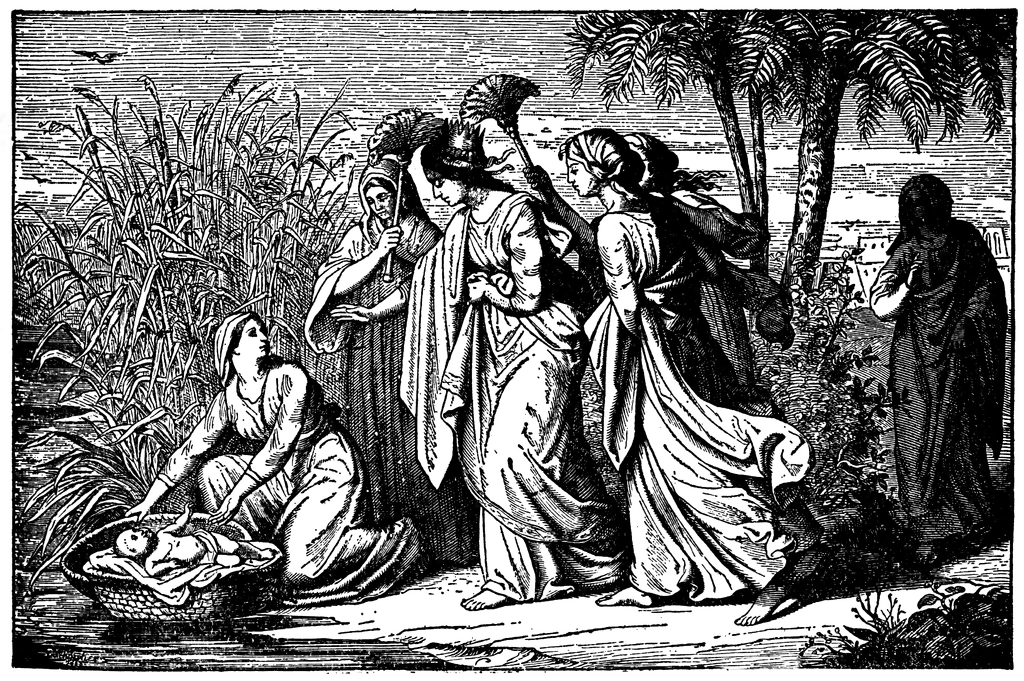
Thutmose I’s daughter, Hatshepsut, is quite evidently the one who found Moses in the basket; and she is the one who named him “Moses”—after her father and mother, Thutmoses and Ahmoses (see C-1). At the time, she would’ve been about 10 years old (plus or minus); and this is why she was accompanied to the river, and needed a nurse to raise the baby (see Exodus 2:5-10). When she was old enough, she took over and raised Moses as her “own son”—evidently, she was preparing him to become pharaoh, because the only other male heir was week and sickly (Thutmose II); but eventually, Moses refused to accept the position of pharaoh (see Exodus 2:10; Acts 7:21,22; Hebrews 11:24-27).
Exodus 2:12,15,23; 4:19 ♦ “… [Moses] slew the Egyptian … when Pharaoh heard this thing, he sought to slay Moses. But Moses fled from the face of Pharaoh … it came to pass in process of time, that the king [Thutmose III] of Egypt died … the LORD said unto Moses in Midian [40 years after he fled (see Acts 7:23,30; Exodus 7:7)], Go, return into Egypt: for all the men are dead which sought thy life.”
Moses was 40 years old, when he fled from pharaoh; so this would’ve been during the reign of Thutmose III—who ruled for almost 54 years. Thutmose III was one of the longest ruling pharaoh’s in Egyptian history; he was the longest of the Eighteenth Dynasty, and the only one who ruled more than 40 years—which is needed, to fit Moses fleeing for 40 years from one specific pharaoh (quoted above).
The exodus happened not long after Thutmose III died, and the first pharaoh after the exodus was Amenhotep II (see C). Amenhotep II was not the firstborn (Amenemhat was firstborn, but he had already died); and indeed, whoever was pharaoh after the exodus could not possibly have been anyone’s firstborn, because they all died in the 10th plague (see Exodus 11:5; 12:12,29; 13:15; etc).
The kingdom of Egypt went from the mightiest world power, with at least 17 military campaigns under Thutmose III—to a struggling kingdom after the exodus, under Amenhotep II, with only one or two campaigns on record; this is because Egypt had lost most of its forces, in the Red Sea. The last campaign was only about 3 years after the exodus, and records taking an unusually large number of captives back to Egypt (~100,000); perhaps this was to replace the escaped Israelite slaves.
In retaliation for the devastation caused by Moses and the plagues, etc: Amenhotep II attempted to completely obliterate all traces of Hatshepsut—in this life and the afterlife—since she is the one who saved Moses from infanticide. This fact has been a mystery to many historians, and still remains without a solid explanation—other than the exodus. Attempts to blame it on Thutmose III, have proven to be very faulty—both in lack of real motive, and also he doesn’t fit the timing of the destruction (20 years or more after Hatshepsut’s death). But Amenhotep II certainly does fit the timing, and would have a perfect motive; furthermore, in at least one case, he specifically stated that he hates the “Semites” (this word comes from “Shem” in the Bible, and probably refers to the Israelites).
Last, but definitely not least: Amenhotep IV (Akhenaten) was the great grandson of Amenhotep II; he reigned in the mid 14th century, and was the 4th pharaoh after the exodus. Certainly, then, he would’ve been aware of Moses, the plagues, and the exodus, etc—perhaps he had even talked face to face, with one or more eyewitnesses of these events. No doubt, Akhenaten had also heard of Israel’s miracles—crossing the Jordan, and the walls of Jericho falling down, etc (see Joshua 2:10,11; 5:1; 9:1-27; 10:1-4; 11:1; etc). Apparently because of these influences: Akhenaten abandoned traditional Egyptian polythesim, in favor of monotheism; yet some rejected his new religion, and he became known as the “Heretic Pharaoh”!
Google AI: “Official records and king lists excluded Akhenaten entirely, often referring to him simply as ‘the enemy’ or ‘that criminal’. Stone reliefs, stelae, and statues bearing his likeness were heavily chiseled and defaced to strike his existence from history [because of hatred, for Akhenaten’s promotion of monotheism—which, quite likely, came from the aftermath of Moses and the exodus].”
——————————————————————————————————————————
C. Chronology of the Eighteenth Dynasty
Now that the exodus is placed solidly in the Eighteenth Dynasty, during the 15th century BC—and even in the middle of that century (between 1450 & 1440 BC)—it’s time to start examining the history of that dynasty, and see if any evidence of the exodus can be found in the Egyptian history (which so many scholars claim does not exist). It’s true that several factors have obscured the reality of the exodus, and these factors include: looking in the wrong century (13th, rather than 15th); looking in the wrong place, for the physical evidence of the Israelites (both in Egypt, and during the 40 years); additionally, Egypt itself attempted to obliterate evidence of Moses, and the exodus, etc. Nevertheless, if the exodus actually happened: then surely some indications of it can still be found, even in secular history.
Exodus Related Events (BC Dates)
1526: Thutmose I begins reign
1524: Moses is born
1514: Thutmose II begins to reign
1501: Thutmose III begins to reign
1479: Thutmose III battle of Megiddo (important chronological anchor)
1447: Thutmose III died
1445: Ten plagues, and exodus
1406: Aaron died
1405: Moses died
1405: Jordan crossing, Jubilee cycle began
C-1. Who Named Moses?
First of all: the name “Mose(s)” is an Egyptian name; and in fact, it was used in the Eighteenth Dynasty—more than twice as much as any other Egyptian dynasty! For example: Ahmose I, Thutmose I, Thutmose II, Thutmose III, Thutmose IV, etc. Also, leading into the Eighteenth Dynasty: two of the last three kings had this name (Ahmose, Kamose). Some historians even spell it with the “s”—like Moses: “Thutmose I (sometimes read as Thutmosis or Tuthmosis I … meaning ‘Thoth [Thut] is born [mose]’)” (https://en.wikipedia.org/wiki/Thutmose_I; see https://en.wikipedia.org/wiki/List_of_pharaohs).
Wikipedia: “She [Ahmose] was the Great Royal Wife of the dynasty’s third pharaoh, Thutmose I, and the mother of the queen and pharaoh Hatshepsut. Her name means ‘Born [mose] of the Moon [Ah]’.” (https://en.wikipedia.org/wiki/Ahmose_(queen)).
Notice that the name Moses means: “born”; and notice also that both of Hatshepsut’s parents had Moses in their names (Thutmose I, and Ahmose). So what did Hatshepsut do, when she found a baby hiding in a basket? She named him after her parents! And the Bible lists an additional reason that she gave, for the name: drawing the baby out of the water (which is actually quite similar to birth).
Exodus 2:10 ♦ “And the child [Moses] grew, and she brought him unto Pharaoh’s daughter, and he became her son. And she called his name Moses: and she said, Because I drew him out of the water.”
C-2. Was Moses Born During the Reign of Thutmose I?
What about the chronology of Moses and Thutmose I, does the timing fit? Moses was 80 years old, at the time of the exodus (see Exodus 7:7; Deuteronomy 31:2). So with an exodus between 1450 and 1440 BC, the birth of Moses would be between 1530 and 1520 BC. And when did Thutmose I begin to reign? Right in the middle of this window (~1526)—that is, if you take high chronology of Egypt, which was the original standard Egyptian chronology; and even now, it’s still promoted by some scholars, and is only 20 years earlier than the current standard (https://en.wikipedia.org/wiki/Thutmose_III).
Wikipedia: “A heliacal rising of Sothis [star Sirius] was recorded in the reign of Thutmose’s predecessor, Amenhotep I, which has been dated to 1517 BC, assuming the observation was made at Thebes [modern Luxor]. … But if the observation were made at either Heliopolis or Memphis [modern Cairo], as a minority of scholars argue, Thutmose would have been crowned in 1526 BC.” (https://en.wikipedia.org/wiki/Thutmose_I).
The middle chronology theory says that the observation of Sirius was taken from Thebes, the capital. However, Memphis was the original capital of Egypt; and: “… it remained an important city throughout ancient Egyptian history … [including] considerable royal focus [in the 18th Dynasty] …” (see quote below). If the observation point was ever moved, from Memphis to Thebes: that would interrupt the Sothic cycle (1460/1461)—which the Egyptians were no doubt familiar with, and it’s likely that they did not want to interrupt it (https://en.wikipedia.org/wiki/Sothic_cycle). The famous Giza pyramids are in Memphis; and they are known for their astronomical connection—as much or more than anywhere else in ancient Egypt (https://en.wikipedia.org/wiki/Giza_pyramid_complex#Astronomy).
Wikipedia: “Memphis … Capital of ancient Egypt … remained an important city throughout ancient Egyptian history. … At the beginning of the Middle Kingdom, the capital and court of the king had moved to Thebes in the south … Although the seat of political power had shifted, Memphis did remain perhaps the most important commercial and artistic center … Some Eighteenth Dynasty kings, particularly Amenhotep II [first pharaoh after exodus] … and Thutmose IV … gave considerable royal focus to Memphis …” (https://en.wikipedia.org/wiki/Memphis,_Egypt).
C-3. What Year Did Thutmose III Die?
In order to understand the exodus year and date: it is not necessary to know which year Thutmose III died. Nevertheless, there are some specific records, regarding the chronology of his reign; so the exact year and date of his death actually can be known, with reasonable certainty. A good starting point is finding the year and Julian date, for the famous battle of Megiddo.
Wikipedia: “According to Thutmose III’s Hall of Annals in the Temple of Amun at Karnak, the battle [of Megiddo] occurred on ‘Year 23, I Shemu [day] 21 [9-21 Egyptian], the exact day of the feast of the new moon’” (https://en.wikipedia.org/wiki/Thutmose_III).
In order to find the Julian date for this battle, we need to find a year where 9-21 Egyptian lands on a “new moon”—during the reign of Thutmose III. Actually, if we use the same high chronology that fits Thutmose I (above), and if we use the standard new moon (first visible crescent): there is only one year that fits. Saturday, May 15, 1479 BC is a new moon; and it’s also 9-21, on the Egyptian calendar.
Wikipedia: “It has been claimed that this was April 16, 1457 BC [based on Middle Chronology;] although other publications place the battle in 1482 BC or 1479 BC.” (https://en.wikipedia.org/wiki/Battle_of_Megiddo_(15th_century_BC)).
Yet some say that ancient Egypt used morning invisible crescent to start the lunar month (rather than the standard first visible evening crescent). One striking problem with this theory, though, is the need to “correct” the Megiddo battle date, from 9-21 to 9-20 (see quote below). When using the standard new moon, which is first visible crescent (for 1479): there is no need to make any so-called corrections, to this most significant battle in history—which no doubt was documented very carefully, and accurately!
Thutmose III’s First Lunar Date: “It is impossible to believe that for a whole day the armies sat and looked at one another, and it is equally hard to credit the whole of the 20th was taken up with preliminary manouevring [maneuvering]. … it is hard to avoid the conclusion that either the scribe who wrote up the narrative from his rough field notes, or the sculptor who transferred it to the temple wall, made a mistake in the date, and that for ‘day 21’ we should read ‘day 20.’” (by Glenn Lello, page 327; The University of Chicago, 1978; see also The Lunar Dates of Thutmose III and Ramesses II; page 40, by Richard Anthony Parker; The University of Chicago Press, 1957; and Raymond O. Faulkner, “The Battle of Megiddo”, Journal of Egyptian Archaeology, Volume 28, 1942; pages 2-15; see 4,11).
Even if the armies did nothing for a whole day, before attacking: that has certainly happened in other battles; and if it happened in this case, it was probably the hand of Jehovah who delayed it—so that it would land on God’s intended date (Saturday, May 15, 1479 BC). Exactly thirty-four years later: the Egyptians themselves would drown in the Red Sea, on this same date (5-15, Julian). And this date is even more significant, for the Biblical battle of Megiddo (more on this, yet to come, in 7GRAILS articles).
Regnal Years and Civil Calendar in Pharaonic Egypt: “For the periods preceding the Eighteenth Dynasty … there is a little more evidence to confirm the fact that regnal years normally changed on New Year’s Day. … Here [New Kingdom] the system of regnal years differs so completely from that which both preceded and followed it … The innovation of the Eighteenth Dynasty lay in its reckoning each regnal year from accession day to accession day, no attempt being made to bring regnal and civil year into harmony with one another.” (pages 21-23; see 16,24,26; by Alan H. Gardiner; Sage Publications, 1945).
The Eighteenth Dynasty used a different method for the chronology of kings, than ancient Egypt used before and after that dynasty (as shown in the above quote). It’s possible that this dynasty also used a different method to start lunar months, than other dynasties (that is, even if other dynasties used morning invisible crescent, rather than first evening visible crescent). Either way: the Megiddo date (May 15, 1479 BC) is a strong anchor, which allows us to calculate the entire reign of Thutmose III, to the day: May 3, 1501 BC (9-4 Egyptian) to March 17, 1447 BC (7-30 Egyptian); this is based on a recorded reign of 53 years, 10 months, and 26 days (https://en.wikipedia.org/wiki/Thutmose_III). So his death in 1447 BC fits very well with exodus, between 1450 and 1440 BC (and probably near the middle of that range).
C-4. Did the Exodus Pharaoh Outsmart God’s Judgment, in the Red Sea?
In order to support a wrong exodus pharaoh, some have taught that he did not die in the Red Sea. Yet all ten of the plagues included pharaoh: so why wouldn’t the last and worst judgment of all, drowning in the Red Sea, also include pharaoh? Where is the justice, in letting the guiltiest person of all—escape?? Or perhaps was Pharaoh smarter than God, and weaseled his way out of God’s judgment???
Exodus 9:15,16 ♦ “For now I will stretch out my hand, that I may smite thee [Pharaoh] and thy people with pestilence [plagues]; and thou [Pharaoh] shalt be cut off from the earth [die in the Red Sea].”
Exodus 14:4,17,18,23,28 ♦ “And I will harden Pharaoh’s heart, that he shall follow after them [Israel]; and I will be honoured upon Pharaoh, and upon all his host; that the Egyptians may know that I am the LORD. … And I, behold, I will harden the hearts of the Egyptians, and they shall follow them: and I will get me honour upon Pharaoh, and upon all his host, upon his chariots, and upon his horsemen. And the Egyptians shall know that I am the LORD, when I have gotten me honour upon Pharaoh, upon his chariots, and upon his horsemen. … And the Egyptians pursued, and went in after them to the midst of the sea, even ALL Pharaoh’s horses, his chariots, and his horsemen. … And the waters returned, and covered the chariots, and the horsemen, and all the host of Pharaoh that came into the sea after them; there remained NOT so much as ONE of them.”
Exodus 15:1,19,21 ♦ “I will sing unto the LORD, for he hath triumphed gloriously: the horse and his rider hath he thrown into the sea. … For the horse [singular] of Pharaoh went in with his chariots and with his horsemen into the sea [none survived, that went into the sea (see above quote)], and the LORD brought again the waters of the sea upon them … the horse and his rider hath he thrown into the sea.”
Psalm 106:11; 136:15 ♦ “And the waters covered their enemies [Pharaoh was enemy #1]: there was not ONE of them left. … But overthrew [killed] Pharaoh AND his host in the Red sea …” (see 135:9).
Deuteronomy 7:18-24 ♦ “Thou shalt not be afraid of them: but shalt well remember what the LORD thy God did unto Pharaoh, AND unto all Egypt … so shall the LORD thy God do unto all the people of whom thou art afraid. … until they that are left, and hide themselves from thee, be destroyed. … But the LORD thy God shall deliver them unto thee, and shall destroy them with a mighty destruction, until they be destroyed. And he shall deliver their kings into thine hand, and thou shalt destroy their name from under heaven: there shall no man be able to stand before thee, until thou have destroyed them.”
Nehemiah 9:11 ♦ “And thou didst divide the sea before them … and their persecutors [Pharaoh was the lead persecutor!] thou threwest into the deeps, as a stone into the mighty waters.”
There’s not a single trace of Biblical evidence, that Pharaoh didn’t die in the Red Sea. There are many truths in the Bible, which are hidden (see Proverbs 2:2-5; 25:2; Matthew 11:25; 13:10-17,44; Luke 10:21; 19:42; etc). However, Pharaoh’s death is not even hidden—it is stated directly, in several passages; without a doubt, then, the exodus Pharaoh was DEAD (Decalogue Exodus Alignment Dates).
C-5. NOBODY Has the Correct Exodus Pharaoh
Who was the exodus Pharaoh? This is a question of great interest, to many; and so far, NOBODY has given the correct answer. As mentioned above, one popular theory is Ramesses II; but he lived in the wrong century (see B-1). And for those who have the correct century: theories include Amenhotep II, or Thutmose (I, II, or III), etc. However, there are two main problems, with all of these pharaoh’s; it seems that everyone has missed these two points: first, all of those reigns were way too long (see C-3 & C-4); and second, none of them were usurpers to the throne, but the exodus pharaoh was a usurper!
Romans 9:17 ♦ “For the scripture saith unto Pharaoh [in Exodus 9:16], Even for this same purpose have I [God] raised thee up [Strong’s #1825], that I might show my power in thee …”
Exodus 9:16 ♦ “… for this cause have I [God] raised thee up [#5975], for to show in thee my power …”
Strong’s #1825 is used in 1 Corinthians 6:14, for resurrection (literal and/or symbolic); in context, though, it certainly does not mean birth. Strong’s #5975 is used more than 500 times in the Bible, and not once is it translated “born” or “birth” or “begotten” or “begat”—so again, it’s not referring to the exodus pharaoh’s birth; instead, it’s referring to God selecting someone who was already living in wickedness, and then guiding his adult life: so that he would be raised up, to the position of king (of course, this truth is a catastrophe for Calvinism). And we know, from several scriptures, that God: “removeth kings, and setteth up kings” (Daniel 2:21; see Isaiah 44:24,28; 45:1-5; 46:9-11; Jeremiah 25:9; 27:6; 43:10; etc).
Now if the Exodus pharaoh was the normal heir apparent (oldest, and/or best fit living genetic son of the previous pharaoh): then surely God would NOT need to intervene, to put the exodus pharaoh on the throne! Therefore, since God did indeed intervene—and even told us that He did—then we can be quite certain that the exodus pharaoh was a usurper, probably not even a relative of the 18th Dynasty families.
Many scholars believe that Amenhotep II had a short co-reign, with his father; but that idea is not stated directly, in any ancient document. If there was a co-reign: where would the exodus pharaoh fit, between Thutmose III and Amenhotep II? The usurper must’ve rose to power, sometime after the death of Thutmose III—very shortly after seems likely, because the transition of power is usually the weakest time; but unless historical records of the usurper are ever found, it’s hard to say exactly when and how the usurper got his power (or exactly how long he reigned). What we do know, for sure, is that he rose to power shortly before the exodus (and after the death of Thutmose III)—and he died in the Red Sea; therefore, at most his reign was just a couple of years.
But don’t go searching for his name, in the history books—it’s not there! That is one of the main reasons, why there has been such trouble locating the exodus pharaoh; there is no clear record of him. He didn’t reign long enough, to leave a very big footprint (being a usurper, he probably didn’t start right off by building monuments of himself—first, he had to establish and maintain his power).
And Amenhotep II probably deleted all evidence, of the usurper’s existence—at the same time when he tried also to erase Hatshepsut’s existence, and nearly succeeded: even though she reigned for more than 20 years, and was one of the greatest female rulers of all time! How much easier it would’ve been, then, to successfully erase every trace of the usurper—who only ruled for about two years, or less!
After the usurper died: Amenhotep II either came to power for the first time, if there was no co-reign—or else came back to power, if there was a co-reign. Whichever was the case: he survived through the reign of the usurper, perhaps by going into hiding. There is one thing that all Egyptologists agree upon: the records about Amenhotep II (including the date of his accession, whether there was a co-reign with his father, when and how many military campaigns he led, etc) are confusing, contradictory, and/or rather vague; plus, he is known for exaggerating, making unreliable claims, etc. All of this makes perfect sense: if the exodus actually happened, just before Amenhotep II’s sole reign; and then there was a cover-up, in order to hide the usurper’s reign and exodus, etc.
——————————————————————————————————————————
D. The Timing of the Jordan Crossing
Several chronological details are recorded, in sacred history, about the Jordan crossing. And this information is left on record, for important reasons—including the fact that it is very valuable in arriving at the correct year, and even the exact day, for the exodus. So section D here is background, which will come in handy in the following two sections (E & F). Also, all chronologies can be verified, at various websites; currently, the best one is Torah Calendar: https://TorahCalendar.com/ (in some cases, the first Hebrew month, on that website, will be one month early—for example, 1445 BC).
D-1. They “Came Up Out of Jordan” on 1-10
Joshua 4:19; 5:10 ♦ “And the people came up [Strong’s #5927] out of Jordan on the tenth day of the first month, and encamped … in Gilgal, and kept the Passover on the fourteenth day of the month …”
The 10th day began the Passover ceremonies, which it specifically states that they “kept”; and crossing the Jordan is certainly no time to be setting aside their Passover lambs, etc (see Exodus 12:1-6). Here is yet another important chronology detail, which apparently everyone has missed. It says that they “came up out of Jordan” on the 10th day—it does not say that they “passed over [Strong’s #5674]” on the 10th (see Genesis 32:10; Numbers 33:51; Deuteronomy 27:3; Joshua 2:23; 3:1,16,17; 4:1,7,10-13,23; 5:1; Judges 8:4; 10:9; 2 Samuel 2:29; 10:17; 17:22,24; 24:5; etc).
They were a very large group; so it took them all day to cross, and into the next day—evening at least, if not into the night. Parallels with both the Red Sea crossing, and the Crucifixion, indicate that they finished coming up out of the riverbed (which is symbolic resurrection) after midnight, and before dawn. This means that they started crossing the Jordan on the 9th day, and finished crossing on the 10th day!
This difference (between “came up” and “passed over”) is one of many ways that God used, to hide the true chronology. Timing is very mathematical; and if you get even one day off, you can get way off track in many ways.
D-2. Only Two Sets of “Three Days”
As detailed below, Moses died in the beginning of the last Hebrew month (see F-7); and then there was one month of mourning. So the first few chapters of Joshua, leading up to the Jordan crossing, took place early in the first month (of the new Hebrew year). This also fits with the above data, that the Israelites crossed Jordan on the 9th and 10th days of the first month.
Joshua 1:10,11; 2:1,16,22,23; 3:1-7 ♦ “Then Joshua commanded the officers of the people, saying, Pass through the host, and command the people, saying, Prepare you victuals; for within three days ye shall pass over this Jordan … And Joshua … sent out of Shittim two men to spy secretly … And she [Rahab in Jericho] said unto them, Get you to the mountain, lest the pursuers meet you; and hide yourselves there three days … And they went, and came unto the mountain, and abode there three days … So the two men returned, and descended from the mountain, and passed over [Jordan], and came to Joshua … And Joshua rose early in the morning; and they removed from Shittim, and came to Jordan, he and all the children of Israel, and lodged there before they passed over. And it came to pass after three days, that the officers went through the host; And they commanded the people, saying, When ye see the ark … then ye shall remove from your place, and go after it. Yet there shall be a space between you and it, about two thousand cubits by measure: come not near unto it … And Joshua [had] said unto the people, Sanctify yourselves: for tomorrow the LORD will do wonders among you. And Joshua spake unto the priests, saying, Take up the ark of the covenant, and pass over before the people. And they took up the ark of the covenant, and went before the people. And the LORD said unto Joshua, This day will I begin to magnify thee in the sight of all Israel …”
Barnes’ Notes on the Bible: “It is the view of the majority of commentators – Jewish and Christian, ancient and modern – that the ‘three days’ here named [Joshua 1:11] are identical with those of Joshua 3:2; and that the command of Joshua in the text was not in fact given until after the return of the spies. Here, as elsewhere in the Hebrew historical books and frequently in the Gospels, the order of time is superseded by the order of thought. … Having placed this leading fact [Jordan crossing] in the forefront, he returns to mention in Joshua 2 [the Jericho spies] …” (https://biblehub.com/commentaries/joshua/1-11.htm).
So there are only two sets of “three days” (shown above in tan highlight, and yellow highlight)—not three or four sets; and chronologically, the Jericho spies happened first. The actual sequence, then, is as follows. On 1-3, the two spies left Shittim, and went to Jericho; they didn’t leave Jericho until “dark” (see 2:5-7), and their “three days” did not start—until arriving in the mountains (see 2:16,22). So 1-4, 1-5, and 1-6 were spent in the mountains; and then they returned to Shittim. On 1-7, the people were told to prepare food for the trip to Jordan, and the crossing—which would take three days: 1-7, 1-8, and 1-9 (food for 1-10, would be prepared and eaten on 1-10). After preparing the food, they traveled from Shittim to the Jordan; and then on 1-8, Joshua said: “Sanctify yourselves: for tomorrow [1-9] the LORD will do wonders …” (3:5). The actual crossing began on 1-9; and it was completed after sunset, which would be 1-10. Then, a few days later, they observed the Passover (detailed next).
D-3. What Day of the Week Did the Manna Cease?
Thursday: Passover, 1-14 (Hebrew); April 20 (Julian), 1405 BC
Friday: “morrow after” the Passover, they ate “old corn” (1-15, Hebrew; 4-21, Julian)
Saturday: “manna ceased on the morrow after … old corn” (1-16, Hebrew, and Wave Sheaf; 4-22, Julian)
Joshua 5:10-12 ♦ “And the children of Israel encamped in Gilgal, and kept the Passover on the fourteenth day of the month [on 1-14] at even in the plains of Jericho. And they did eat of the old corn of the land on [1-15] the morrow after the Passover, unleavened cakes, and parched corn in the selfsame day [on 1-15]. And the manna ceased [Strong’s #7673, shabath] on [1-16] the morrow after they had eaten of the old corn of the land; neither had the children of Israel manna any more [no manna on 1-16, or 1-17, or ever after]; but they did eat of the fruit of the land of Canaan that year.”
First of all, this is obviously the record of the Hebrew date (1-16), when the manna permanently stopped; this is also the record of why the manna stopped—because they had entered Canaan, and didn’t need it anymore (see Exodus 16:35). Perhaps even more important: this is the record of the Wave Sheaf ceremony—because they ate of the “old corn” on 1-15, but afterward they ate of the new crops from Canaan; and this was not allowed, until after they had presented the Wave Sheaf (see Leviticus 23:10,14). It says the manna ceased on 1-16, and there are only two possible reasons for this: either it was the Wave Sheaf day (they could eat of the new crops, so they didn’t need the manna)—and/or it was the weekly Sabbath (see Exodus 16:4-30).
If 1-16 was not on a Saturday that year (the first option): then 1-16 had to be the Wave Sheaf day (because this is the only other reason for the manna to cease). And if this was the case: then 1-16 that year could’ve theoretically been on any day of the week (without looking at the wider context); and if so, it would be a very strong support for Wave Sheaf always on 1-16 (rather than always on Sunday, which is the popular but incorrect view). Had 1-16 been on any day other than Sunday that year: then we would know that Wave Sheaf does not always come on Sunday! And if 1-16 did come on Sunday that year: then certainly the manna would’ve ceased on Saturday 1-15 (since manna never fell on Saturday, which is the day before Sunday); but the manna did NOT cease on 1-15, so we know that Wave Sheaf was not on Sunday that year (at least not with this first option).
If the second option is correct (manna stopped on Saturday): then we would know how the days of the week lined up, with the Hebrew dates (1-16 was on Saturday, etc)—which is the goal. Even if 1-16 was the Sabbath (Saturday): the manna did not return again, on 1-17 (Sunday); so in this case, the Wave Sheaf would’ve been presented no later than Sunday (because on 1-17 they had no manna, and were eating of the new crops).
A third possibility—or rather a combination of the first two possibilities—is that 1-16 was both options, on the same day (Wave Sheaf, and Saturday). And if this is the actual case: then, once again, we would know how the days of the week lined up (1-16 would’ve been a Saturday, that year). Plus, if this timing is correct: then again, the Wave Sheaf would be on Saturday, NOT always on Sunday!
In all cases: the Hebrew word translated “ceased” is Strong’s #7673, shabath; this word is related to the word “Sabbath”—and in fact it is specifically used of Israel not getting manna on the Sabbath: “So the people rested [shabath] on the seventh day.” Although #7673 is not used exclusively of the weekly Sabbath: yet there are at least half a dozen cases, where this Hebrew word does refer to Saturday (Exodus 16:29,30; see 23:12; 31:17; 34:21; Genesis 2:2,3). So it is likely that 1-16 was on Saturday, that year; and if so, we can verify it by looking at other events, listed in the context (see E-1).
——————————————————————————————————————————
E. The Year of the Exodus
With the death of Thutmose III in March of 1447 BC: the exodus year has been narrowed down to 1447 or after. And as noted earlier, 1446 or 1445 fits best with the 480 years of 1 Kings 6:1; these years also fit very nicely with God sending Moses back to Egypt, not long after Thutmose III died. Then which one of these two years, 1446 or 1445 BC, is the actual year of the exodus?
E-1. The Year of the Jordan Crossing
The details of the Jordan crossing have already been covered (see D); so now we can look at what year fits those details. Then, knowing the Jordan year, will help locate the exodus year also—because the Israelites were in the wilderness for about 40 years, after the exodus and before entering the promised land (see Exodus 16:35; Numbers 14:33,34; 32:13; 33:8; Deuteronomy 1:3; 2:7; 8:2,4; 29:5; Joshua 5:6; Nehemiah 9:21; Psalm 95:10; Amos 2:10; 5:25; Acts 7:36,42; 13:18; Hebrews 3:9,17; etc).
Understanding the importance that God put into the seventh day—the weekly Sabbath—is a big key, to unlocking the Jordan crossing year (and other chronology). We know that God gave the Sabbath as a holy day every week; and He commanded His people not to “work” on that day (see Exodus 20:8-11; 31:12-17; 35:2; Numbers 15:32-36; etc). Travel on the Sabbath was permitted, to some degree; but only for important spiritual reasons (see Exodus 16:29; Isaiah 58:13; Matthew 12:5; 24:20; Acts 1:12; etc).
We have already noticed that the manna ceased on 1-16, which was likely a Sabbath (see D-3); this was an important day, because it was also the Wave Sheaf day (see F-5). So this timing places the Jordan crossing, squarely on the seventh day of the week; no doubt God did this intentionally, because the Sabbath-rest represents the ultimate rest—for those who enter the heavenly Canaan (see Hebrews 4:3-11; etc). By God’s special plan: the Red Sea was also crossed, on the seventh day of the week (see F-5).
Moses died on the first day, of the last month; and then Israel mourned him for one month—which lasted until New Year’s Day (see F-7). That day was a Friday; and the next day was spent resting, on the Sabbath. Then Sunday morning, Joshua sent the spies to Jericho. They were in Jericho on Sunday; and then they spent Monday, Tuesday, and Wednesday: 3 days, in the mountains. Joshua then told the people to prepare food for three days (Thursday, Friday, and Jordan crossing). This alignment is perfect, because no food was prepared on the Sabbath (see Exodus 16:22-30); and also because all travel was done on regular weekdays—except the most important day and event of all, the Jordan crossing.
Once again, the Wave Sheaf day was one week later: 1-16 H, on Saturday. The next day was the first time in 40 years, when no manna fell on Sunday. They were finally in their new home (Canaan), and they didn’t need the manna anymore. This day was also New Year’s Day, on the Chromo calendar, for that year (https://7GRAILS.world/7-symbolic/chr/bcd/).
This same day, 1-17 Hebrew calendar (Sunday), was also the day when God had the Israelites start marching around Jericho; and they did it every day, for six days, and then on the “seventh day” the walls collapsed (Joshua 6:4,15-20). Days one through seven of marching around Jericho, in that year, lined up both with days one through seven of the Chromo calendar (1-1 through 1-7)—and with days one through seven of the weekly cycle (Sunday through Saturday). And this was the fourth special event Sabbath, for that month (end of mourning for Moses, Jordan crossing, Wave Sheaf, and Jericho collapse). All theses events and Sabbaths line up in one and only one year: 1405 BC (but not in 1407, 1406, 1404, 1403, etc); and the spring of 1405 is exactly 40 full years, after the exodus in 1445 BC! Furthermore, 7GRAILS has an entirely different article—about the Jubilee cycles—that also lines up with the Jordan crossing, in this same year: 1405 BC (https://7GRAILS.world/7-symbolic/chr/70jubilee/).
Notice that 1446 to 1405 is 41 full years (standard reckoning), as well as 42 years with inclusive reckoning; so either way, 1446 is not the correct exodus year. Notice also that Aaron and Moses died in the “fortieth year” after the exodus (see Numbers 33:38; Deuteronomy 1:3; 34:5-8); and this is certainly inclusive reckoning (see E-2). Therefore, the Jericho Passover, in 1405, was exactly 40 full years after the exodus (and the beginning of the 41st year, inclusive).
E-2. The Numbers Line Up With What Year?
Exodus 40:17 ♦ “And it came to pass in the first month in the second year, on the first day of the month, that the tabernacle was reared up.” (see 40:2).
The exodus occurred on Passover (1-14); and the tabernacle was set up, slightly less than one year later (on 1-1). Yet the record says “second year”; this proves that inclusive reckoning was used, to count the years from the exodus. So most likely, the 480th year is also inclusive: “… in the four hundred and eightieth year after the children of Israel were come out of the land of Egypt …” (1 Kings 6:1). If so, the exodus would be 1445, which is one year later than non-inclusive (966 temple year + 480 = 1446; but inclusive reckoning decreases the total span by one, leaving 1445).
Speaking of 1445: if you multiply each of these numbers, the answer is 80 (1 x 4 x 4 x 5 = 80); and we know that Moses was 80 years old, at the time of the exodus (see Exodus 7:7). Is this just a coincidence? Perhaps; but neither 1446—nor any other year in the same decade—multiplies (or adds) to equal 80. In fact, there is only one other year in the entire century, which equals 80 (1454); so if this is a coincidence, the odds are 2 in 100 (2% chance coincidence, and 98% chance not coincidence).
Furthermore, the Passover and exodus started on the 14th day of the month (see Exodus 12:6,18; Leviticus 23:5; Numbers 9:5; 28:16; 33:3; Joshua 5:10; 2 Chronicles 35:1; Ezra 6:19; Ezekiel 45:21; F-4). And again, 1445 fits perfectly when you add the numbers: 1 + 4 + 4 + 5 = 14; but 1446 does not equal 14 (nor does any other year, in that same decade). Does God operate this way? Does He hide the truth, in numbers and math? Yes! Many people don’t realize it; but He does teach truth with numbers (see F; Revelation 13:18; https://7GRAILS.world/babel/66books/). Yet in no case, is any hidden math or number the primary support for any truth; direct quotes in the Bible, and in history, are always primary—and then sometimes, God gives additional support through numbers.
Last, but positively not least: the exact day of the exodus fits with one and only year; there is only one year, where everything lines up: all the calendars, and the days of the week, and the dates, etc. And what year might this be? You guessed it, 1445.
——————————————————————————————————————————
F. The Day and Date of the Exodus
In this section, we want to understand what day of the week the exodus occurred; also, we want to know the exodus date, on the Julian calendar (month, and day of the month). Once these two questions are answered: we will have positive verification of the correct century, and the correct year, of the exodus. In brief, 1445 BC fits all nine of the following points (no other year fits even half of these nine points).
#1 430 years after Isaac was sacrificed.
#2 The birth and death dates of Moses and Aaron.
#3 Moses rescued from the basket, on Pentecost (and ark first transported, on the 80th Julian anniversary).
#4 The ten plagues on Egypt, starting equinox Sunday.
#5 Thursday Passover, through early Sunday morning Wave Sheaf—just like the crucifixion chronology.
#6 These same days of the week, and the Julian dates, are hidden in plain sight (in Deuteronomy 5:12-15).
#7 The law from Sinai was given on the seventh day of the week.
#8 The Jubilee cycle, Jordan crossing in 1405 BC, and alignment with the days of the week in that month.
#9 The 480 years (inclusive), before Solomon started to build the temple in 966 BC.
F-1. How Long Were the Ten Plagues?
Some think that the plagues on Egypt lasted one year, and others say about six months, etc. The Bible is clear that the plagues did not last a whole year. Moses was 80 years old before the plagues started; and we know this is not a round number, because the exact age of Aaron (83) is given in the same verse (see Exodus 7:7). Moses was born around the beginning of the last Hebrew month (see F-7); and the exodus came in the middle of the first Hebrew month (Passover, 1-14). The plagues had to start after Moses’ birthday, and of course they ended on Passover—for a maximum of about two or three months. Anything longer than this, and Moses would’ve turned 81 during the plagues; then 40 years after the exodus, he would’ve died at 121—but instead he died at 120 (see Deuteronomy 1:3; 31:2). So there simply isn’t room for a whole year of plagues, or anything longer than two or three months.
The Bible doesn’t give an exact duration of all ten plagues combined; however, we are told that the first plague was “seven days” (Exodus 7:25)—and the ninth plague was “three days” (10:22,23). If all of the plagues were just 3 days long, the total would be 30; and if they were all 7 days long, the total would be 70. But we know that they weren’t all the same length, so between 30 and 70 seems reasonable.
Also,
if we add
the two plagues, with known
lengths (3 + 7): the total is 10
days—leaving
eight
more plagues of unknown
duration. It’s probable that several
of the plagues only lasted a day
or two
(see
Exodus 8:1-14,28-31; 10:13-19);
and in some cases, there was at
least one
day after
the previous plague, before
the next
one started (see
8:18-24,31; 9:1-6,13-19; 10:4).
Now, if we estimate 1.5 days average length, for the eight plagues of unknown duration (some two days, some one day): that would add 12 more days (for a total of 22 days, including the first and ninth plagues). If the average time between plagues were 2 days, it would add another 18 days (9 gaps between the 10 plagues). This would now bring the grand total to 40 days—a number that is found repeatedly in the Bible; and it’s definitely related to the exodus and Moses (see Acts 7:23-30).
Jehovah’s judgment on Egypt was the ten plagues; and His judgment on Israel was the 40 years (in the wilderness)—because of their unfaithful reaction, to the 40 days of searching in Canaan (see Numbers 14:34). Jesus Himself suffered in the wilderness for 40 days—not because of anything He did wrong, but because He was suffering God’s judgment on our behalf (see Isaiah 53:3-12; 1 Peter 2:24; 1 John 3:5; etc). Therefore, 40 days is a very likely duration, for God’s judgment on Egypt (the plagues).
F-2. Did the Hebrew Year Start in March, or April?
If we look at the Hebrew calendar for 1445 BC (the year that is lining up best so far): we find two potential months, that could’ve been month 1 (for that year). How do we know which month was actually the first, in that year? There are a few methods for calculating the first Hebrew month: first Passover after spring equinox, or new moon that is closest to equinox, or first new moon after equinox, etc. But the reality is that God’s original system was not calculated; instead, it was based on observation of the season, as indicated by nature (spring barley, trees, flocks, weather, roads, etc). So the only way to know for sure, is to look at both options—and see which one fits the Biblical record, and God’s plan.
The first option would put Passover (and the exodus) on April 12; but this option has at least two problems. One problem is that Moses would’ve turned 81 years old, during the 40 days of plagues; and then he would’ve turned 121 before he died (as mentioned above). Another problem is the days of the week: April 12 (in 1445 BC) is a Tuesday; but the exodus Passover was on a Thursday (see F-5 & F-6).
With the second option: Passover would indeed be on a Thursday, May 12. And with this option: Moses would’ve already had his birthday, just a few weeks before the plagues started (so he had recently turned 80, when he first warned Pharaoh about the plagues); then he would die at 120, 40 years later, as the Bible says (see Deuteronomy 31:2).
The most interesting thing, about this May 12 Passover, is how nicely it lines up with the 40 days of plagues. The first plague would’ve started on April 3, which was a Sunday! Now we can see why the first plague was “seven days”—because God lined it up with the seven days of the week (Sunday through Saturday). Even more amazing: Sunday, April 3, 1445 BC—was the equinox!! Yes, God knew all about the festivals, when the Egyptians would venerate their false gods: including and especially on the spring equinox (https://en.wikipedia.org/wiki/Wheel_of_the_Year). So God sent them His judgments, beginning on the very day that was especially connected with their idolatry.
Google AI: “The ancient spring festival now known as Sham Ennessim was observed to coincide with the spring equinox. … However, its scheduling has changed over the millennia. Following the introduction of Christianity to Egypt, the date was detached from the astronomical equinox and is now celebrated annually on the Monday following Eastern Orthodox Easter [1 , 2 , 3, 4].”
Wikipedia: “Sham Ennessim … is a festival marking the beginning of spring [originally observed on the equinox] … It is an official public holiday in Egypt. … The festival is characterized by a number of traditional practices. … along the Nile [etc] … The exact origin of the festival remains insufficiently documented; however, it is generally held that Sham Ennessim was celebrated by Egyptians as far as ancient Egypt.” (https://en.wikipedia.org/wiki/Sham_Ennessim).
CNN: “Is this the world’s stinkiest holiday? It’s the world’s oldest ironic holiday. To discover the festival Shem En-Naseem, or ‘smell the breeze’ in Arabic, the first stop is a fish market. … The ancient festival dates back to the age of the pharaohs. The receding Nile flood stranded fish, leaving them to rot.” (Ian Lee, 4-15-2015; https://www.cnn.com/travel/article/rotten-fish/index.html).
This is most amazing!!! The first plague, which came on the spring equinox, was dead and stinky fish in the river Nile—which is the very thing that this ancient Egyptian spring festival is all about! “And the fish that is in the river [Nile] shall die, and the river shall stink …” (see Exodus 7:14-25). So God struck the Egyptians on the VERY DAY (equinox), that they observe this stinky fish festival on the Nile; but don’t worry: THERE IS NOT AN ATOM OF EVIDENCE, IN THE WHOLE UNIVERSE, that the exodus is actual history (it’s just a myth); either that, or people don’t WANT to accept the exodus as fact!
F-3. Does “Selfsame Day” Mean Anniversary?
Exodus 12:40-42,51 ♦ “Now the sojourning of the children of Israel, WHO dwelt in Egypt, was four hundred and thirty years. And it came to pass at the end of the four hundred and thirty years, even the selfsame day it came to pass, that all the hosts of the LORD went out from the land of Egypt. It is a night [singular] to be much observed unto the LORD for bringing them out from the land of Egypt: this is that night of the LORD to be observed [Passover] of all the children of Israel in their generations. … it came to pass the selfsame day, that the LORD did bring the children of Israel out of the land of Egypt …”
Many think that the Israelites were slaves in Egypt, for the entire period of 430 years; but actually, they were only in Egypt for about half of that time, and they were slaves for less than 100 years (see Acts 7:17-21). The verse says “WHO” dwelt in Egypt (Israel), not HOW LONG they dwelt in Egpyt; no verse in the Bible specifically states how long they were living in Egypt. The 430 years did not begin, when Israel went into Egypt; instead, they began with the sacrifice of Isaac, in 1875 BC. This year is not selected, merely to fit a 1445 BC exodus—instead, this 1875 date is validated independently of the exodus (https://7GRAILS.world/7-symbolic/chr/abcd/); yet it does fit perfectly, with the 1445 year.
Regardless of what event started the 430 years: many think that “selfsame day” means Israel left Egypt on an anniversary (of the event that started the 430 years). But the beginning and ending events (Isaac sacrifice, and exodus) don’t fall on the same date, in any of the Biblical calendars (unless you jump from Gregorian to Julian, during the 430 years—which is certainly not the main point, of “selfsame day”).
Just
a skim
of all the Bible verses—which have the phrase “selfsame
day”—should
be sufficient to show, that the primary meaning is not
an anniversary
concept (although that might be a secondary
application, in some
cases). What it does mean primarily,
if not exclusively, is that certain things all happened
during the same
cycle
of ONE 24-hour day;
but not
any longer
than one day
(see
Genesis 7:13; 17:23,26; Exodus 12:17,41,51; Leviticus 23:14,21;
Deuteronomy 32:48; Joshua 5:11; Ezekiel 40:1).
This is very important information, for exodus chronology—because we are being instructed that Israel did NOT leave Egypt on another day, after Passover; instead, they left Egypt on 1-14! This is yet another piece of the chronology puzzle, that chronologists and theologians have missed. The slaying of the Passover lamb, the meal, the death angel at midnight (last plague), and Israel starting on their journey out of Egypt—all these things happened in one day, known as Passover (1-14). In fact, this very name comes from the event that happened at midnight (see Exodus 11:4; 12:12,13,23-29; etc).
F-4. What Time and What Day was the Passover Lamb Slain?
There is a lot of confusion and controversy, regarding exactly when the Passover lamb was slain (before sunset, or after sunset); and also what Hebrew date the Passover meal was eaten, on the 14th or the 15th (of the Hebrew month). If the lamb was slain before sunset, on the 14th: then the meal after sunset would be on the 15th—along with the angel passing over at midnight, which the Passover is named after; yet all scriptures connect Passover with the 14th (see Leviticus 23:5; Numbers 9:1-5; 28:16; 33:3; Joshua 5:10; 2 Chronicles 30:15; 35:1; Ezra 6:19; Ezekiel 45:21; etc).
If the lamb was slain before sunset, on the 13th: then events after sunset would fit with the 14th; however, the scriptures again point to the 14th as the day when the lamb was slain (see Exodus 12:6; 2 Chronicles 30:15; 35:1). These problems have led some to conclude that the lamb was slain after sunset, not before. Yet even this solution doesn’t solve all the problems; for example, the antitypical Passover Lamb (Jesus) was not slain after sunset—instead, it was a few hours before sunset (see Matthew 27:45,46; Mark 15:33,34; Luke 23:44-46; 1 Kings 18:29-45; etc). Furthermore, this idea leaves no answer for the statement that Israel: “… departed from Rameses in the first month, on the fifteenth day of the first month; on the morrow after the Passover the children of Israel went out with an high hand in the sight of all the Egyptians.” (Numbers 33:3). The record in Exodus 12:40-51 (see F-3) says that they left Egypt during the night, on the 14th day of the month—the “selfsame day” as Passover (on the 14th).
The answer to all these problems, and many more, is very simple; however, very few have noticed it. The real solution is simply that the ancient Egyptians used morning, to begin their days (dawn or sunrise)—not sunset; and God planned for this method to also be used by Israel, during the exodus. This is why we are instructed that all the events—slaying the lamb before sunset, eating the meal after sunset, midnight death angel, Israel departing, etc—all of these events happened on the 14th (and all happened in the “selfsame” 24-hour day: starting one morning, and ending the next morning).
Not until after the exodus, did God tell Israel: “Also on the tenth day of this seventh month there shall be a day of atonement … in the ninth day of the month at even, from even unto even, shall ye celebrate your sabbath.” (Leviticus 23:27,32). If the Israelites were already observing sunset reckoning, for everything, then God did not need to tell them “even unto even” (sunset to sunset); and He certainly did not need to say that the “tenth day” begins on the “ninth day” at sunset—if indeed they were already in the habit of changing the date, in the evening (from 9th to 10th, etc). What about Numbers 33:3, quoted above? It was written after the exodus, and probably after sunset reckoning had become the standard; so based on the sunset method, Israel left Egypt on 1-15 (the morrow after 1-14). For additional details and documentation: Absolutely Best Crucifixion Date (https://7GRAILS.world/7-symbolic/chr/abcd/).
F-5. Red Sea Crossing on Wave Sheaf
So far, we have learned that the exodus Passover started on Thursday, May 12, 1445 BC; and it was after midnight, when they left Egypt (early Friday). The next main miracle was crossing the Red Sea; when did that occur? God told them to go “three days journey” into the wilderness (Exodus 3:18; 5:3; 8:27). But He did not tell them in advance, about getting trapped at the Red Sea (with no apparent way to escape); instead, He brought that unexpectedly, as a test (if you know in advance what is going to happen, it’s not much of a test). So the “three days” was the time traveling through the wilderness, until arriving at the Red Sea (even though God didn’t mention the test, at the end of the three days).
The three days are no doubt inclusive reckoning: Thursday (1-14), Friday (1-15), and Saturday (1-16). This also fulfills the Wave Sheaf, which always falls on 1-16 (see F-6). We know that there was a special event for the exodus Passover, the midnight angel; and there was also a special event for the exodus Feast of Weeks / Pentecost, at Mt. Sinai (see F-6)—so surely there was a special event for the exodus Wave Sheaf! And what would that event be, if not crossing the Red Sea? Both of the other two events were major, and miraculous; so the Wave Sheaf would also need to be major, and miraculous. Nothing fits, except the Red Sea crossing—plus we know that the Wave Sheaf, as well as baptism, both represent resurrection (see Romans 6:3-5; Colossians 2:12,13; 1 Corinthians 15:20,23,29; 1 Peter 3:20,21; etc); and in the quote below, Paul connected the Red Sea crossing with baptism!
1 Corinthians 10:1,2 ♦ “… not that ye should be ignorant, how that all our fathers were under the cloud, and all passed through the sea; And were all baptized unto Moses in the cloud and in the sea;”
So the true exodus chronology fits with the Wave Sheaf, and symbolic resurrection; but it also fits with the antitypical Lamb’s Passover, and literal resurrection: starting on Thursday evening (Lord’s Supper / Passover meal), and ending with resurrection early on Sunday morning. The Red Sea crossing started on Saturday; but it was not completed, until early Sunday morning (see Exodus 13:21,22; 14:19-21,24,27; etc). Yet at that time, the new day started in the morning (see F-4); so it was still 1-16, when they finished crossing the sea. So Thursday evening through early Sunday morning was the sequence of events for Passover—both in type, and in antitype! Again, this validates the 1445 BC year of the exodus, and the Thursday May 12 date (with the sea crossing completed early Sunday morning, May 15).
At this point: it’s not hard to see the Julian exodus date, which God hid in plain sight. It’s true that man is the one who divided the chapters and verses, in the Bible; but if God wanted, He could easily guide the process in some places—so that the chapters and verses line up, according to His plan. Now notice that the days of the week, AND the Julian dates—for the exodus Passover and Wave Sheaf—are perfectly lined up in the Ten Commandments, which were spoken by God on the exodus Pentecost!
The Sabbath Commandment in Deuteronomy (Chapter 5 = May, the 5th Julian Month)
5:12 [May 12 (symbolic marriage), Passover on Thursday] Keep the Sabbath day to sanctify it …
5:13 [May 13, Friday, the sixth day of the week] Six days thou shalt labour, and do all thy work:
5:14 [May 14, Saturday and seventh day] But the seventh day is the Sabbath of the LORD thy God …
5:15 [May 15, early Sunday morn (Wave Sheaf)] And remember that thou wast a servant in the land of Egypt, and that the LORD thy God brought thee out thence through a mighty hand and by a stretched out arm [at the Red Sea!]: therefore the LORD thy God commanded thee to keep the Sabbath day.
Moses stretched out his arm, at the Red Sea: both to open it, for Israel; and also to close it Sunday morning, on the Egyptians (see Exodus 14:16,21,26,27; 15:12; Psalm 136:12-15; etc). It’s true that we think of Sunday morning, as the first day of the week; but they were still on sunrise reckoning: so to them, it was the seventh day—even when the Egyptians drowned. So the four verses line up with the four days, in the Julian calendar (which changes at midnight): May 12 to May 15; and these four days include events from Passover, to Wave Sheaf—yet with sunrise reckoning, it was only three days (1-14, 1-15, & 1-16).
F-6. Pentecost Not Always on Sunday
Speaking of 1-16, and the Wave Sheaf: as mentioned before, some think that the Wave Sheaf always comes on a Sunday (one day after the weekly Sabbath); and if so, then Pentecost would also fall on a Sunday—since it comes 50 days after Wave Sheaf, inclusive (see Leviticus 23:9-16). However, Pentecost always on Sunday is a popular tradition, that is false; for extensive details and documentation, see: Basic CHRonology Details (https://7GRAILS.world/7-symbolic/chr/bcd/).
The exodus is the foundation of all these festivals, and also the Hebrew calendar chronology; so if God wanted us to know that Pentecost should always be on a Sunday, then the exodus would be the perfect time to make that clear—and yet it was not on a Sunday, in 1445 BC, it was on a Saturday. There are several ways to show that the exodus Pentecost was on a Saturday, not a Sunday. First, we have already seen the Wave Sheaf chronology: crossing the sea on Saturday, 1-16, which means that Pentecost would also have to be on a Saturday (whatever day of the week Wave Sheaf occurs, Pentecost will always be on that same day; again, with inclusive reckoning, 50 days is exactly seven full weeks).
Just in case anyone is uncertain, about whether the exodus Wave Sheaf qualified as Saturday or Sunday (since they crossed the Red Sea on both days, using midnight reckoning): there is one easy way to keep all these different methods straight (sunset, midnight, sunrise reckoning, etc). All of these calendars are lined up on the same day of the week, at noon (except in astronomy—which is not a Biblical calendar, and therefore is no factor).
Since the Red Sea Wave Sheaf was fulfilled before sunrise, then the day had not changed yet; and what day of the week was it, at noon on that same day? It was Saturday! So you can’t get a Sunday Pentecost from the exodus, unless you go by sunset or midnight reckoning; but God in His wisdom chose to keep Israel on sunrise reckoning, until later (see F-4).
Furthermore, the weekly Sabbath is yet another important chronology factor, which many have overlooked. God told the Israelites to spend two days getting ready—both physically and spiritually—for when He would speak the law, from Sinai, on the third day (quoted below). Yet if indeed the third day was a Sunday: then God would’ve been asking them to “wash their clothes” on the Sabbath day—which He would never do (see Exodus 20:8-11; 31:12-18; 34:21; 35:1-3; Leviticus 23:3; Deuteronomy 5:12-14; etc). It fits much better, if God asked them to do their laundry on Thursday and Friday; then the law was given on Saturday (Sabbath), which was also the day of Pentecost (and July 2, Julian, 1445 BC).
Exodus 19:10,11 ♦ “And the LORD said unto Moses, Go unto the people, and sanctify them to day and to morrow, and let them wash their clothes, And be ready against the third day: for the third day the LORD will come down in the sight of all the people upon mount Sinai.” (see 19:16-18).
The Bible doesn’t give the exact day of the month, when God spoke the Decalogue; but we do know that it was early in the third month (see 19:1-11). We also know that Pentecost comes early in the third month (3-6, plus or minus one day—depending upon the number of days, 29 or 30, in the first two Hebrew months); this is based on 50 days inclusive, after the Wave Sheaf (on 1-16). According to the next quote: the Decalogue was spoken on a Saturday, and that day was also Pentecost (3-6); and this fits perfectly with the 1445 BC exodus!
Wikipedia: “Shavuot [Pentecost] marked the wheat harvest … Rabbinic tradition teaches that the date [Pentecost] also marks the revelation of the Ten Commandments to Moses and the Israelites at Mount Sinai … According to the classical timeline, the Israelites arrived at the wilderness of Sinai on the new moon [of the third month] (Exodus 19:1) and the Ten Commandments were given on the following Shabbat (i.e., Saturday). … In practice, Shavuot [Feast of Weeks / Pentecost] is observed on the 6 Sivan [3-6] in Israel …” (https://en.wikipedia.org/wiki/Shavuot).
The “seventh day” Sabbath commandment is the only one of the ten, with specific chronology in it; God knew that Saturday would be the perfect day of the week, to give the chronology commandment (at Sinai, along with the other nine commandments). For these same reasons: the “seventh day” (one week later) was the perfect day to call Moses up, and receive the Ten Commandments (see next).
Exodus 24:4,12,15,16 ♦ “And Moses wrote all the words of the LORD, and rose up early in the morning [the day after Pentecost, on Sunday] … And the LORD said unto Moses, Come up to me into the mount, and be there: and I will give thee tables of stone, and a law, and commandments … And Moses went up into the mount … And the glory of the LORD abode upon mount Sinai, and the cloud covered it six days [Sunday through Friday]: and the seventh day he called unto Moses out of the midst of the cloud.”
F-7. Moses Died on His Birthday
Deuteronomy 31:2; 32:48,50 ♦ “… I [Moses] am an hundred and twenty years old this day [his birthday] … And the LORD spake unto Moses that selfsame day, saying … die in the mount … [God chose the exact day for Moses to die, his birthday!] …” (see Deuteronomy 31:14 in NASB and NLT, etc).
Gill’s Exposition of the Entire Bible: “Whether the meaning is, that that day precisely was his birthday, is a question [that is now clearly answered: yes!] … it seems by Deuteronomy 32:48 that having delivered to the children of Israel the song he was ordered this day to write, on the selfsame day he was bid to go up to Mount Nebo and die: and it is a commonly received tradition with the Jews, that Moses died on the same day of the month he was born …” (https://biblehub.com/commentaries/deuteronomy/31-2.htm).
Human tradition can be wrong, but it can also be right; with this Jewish tradition, it is partly right and partly wrong. Moses did indeed die on his birthday; but on the Julian calendar, not on the Hebrew calendar. This Jewish tradition no doubt refers to the Hebrew calendar; and most Jews don’t understand that there are two Biblical calendars, much less three (https://7GRAILS.world/7-symbolic/chr/bcd/). So how do we know if Moses died on his birthday? And if so, how do we know which calendar?
Aaron died, “in the first day of the fifth month [40th year]” (Numbers 33:38; see 33:39; 20:23-39); and they mourned for him 30 days. This is a clue, because it was the same with Moses; they also mourned for him 30 days (see Deuteronomy 34:5-8). So Moses must’ve also died on the first day of some month—and then they mourned for him from the beginning of one month, to the next. And the month that Moses died had to be the 12th month: because he spoke things in Deuteronomy, and wrote the book, starting: “in the eleventh month, on the first day of the month [40th year]” (1:3); and that certainly took more than one day (see 31:9,22-26). Also, Moses could not have died after the 12th month, because that was the Jordan crossing month (see D). Therefore, Moses died the first day of the 12th month (and was mourned for one month, then the Jordan crossing events began).
So in 1405 BC, Moses died on March 9 (Julian, 12-1 Hebrew). Count 120 years backwards, and Moses was born in 1524 BC (inclusive reckoning, Hebrews often counted birth as year 1). In that year: only one calendar, the Julian, has any good alignments. When Moses was born, he was hidden for “three months” (Exodus 2:2; Acts 7:20; Hebrews 11:23); then Hatshepsut rescued him, from the river. If he was born on March 9, then 90 days later (inclusive) lands on the day of Pentecost (June 6, Julian). Yes, God designed for Moses to be rescued on Pentecost—the very day that God Himself would speak the law, at Sinai (and then Moses himself would go up Sinai, to meet with God, and receive the law in stone, etc).
For this to work, on the Hebrew calendar: the birth of Moses would have to be on 12-6 (whatever year); then the rescue, three months later, would be on 3-6 H (Pentecost)—finally, he would have to die on 12-6 (120 years later, on his Hebrew birthday). If this was the case: he would not die on the first day of the Hebrew month (like Aaron); worse yet, there would not be 30 days left to mourn him, before the Jordan crossing events would begin (spies to Jericho, etc). This shows that Moses died on his Julian calendar birthday: March 9, 1405 BC (but not on any Hebrew calendar birthday).
F-8. More Birthday and Anniversary Alignments
The rescue of Moses, on Pentecost, is also verified by yet another Julian alignment: the day that Hatshepsut rescued Moses was June 6, Julian, 1524 BC. Exactly 80 years later—to the very day, on the Julian calendar (but not the same Hebrew date): God told Israel, for the first time since the “ark” was built, to transport it (see Numbers 9:17-23; 10:11,21,33). This happened on June 6, Julian, 1444 BC; but the Hebrew date was 2-20, which is not a Hebrew anniversary of the rescue (on 3-6). It’s also significant that Moses was rescued from an “ark”—but not from a “basket” (KJV); and this is the same Hebrew word used for Noah’s ark, and parallels the Greek word for the Ark of the Covenant (see Strong’s #8392, compare Greek #2787). God used this word (ark, not basket): because He planned for both arks—and their cargo—to be transported, for the first time, on the same Julian date: June 6 (1524 BC & 1444 BC).
With Aaron, the Bible states that he died on the “first day” of the month (Numbers 33:38); but with Moses, we weren’t told which day of the month that he died (although it can be deduced). Yet we were told that, shortly before he died: Moses started Deuteronomy on the “first day” of the 11th month (1:3). And why is this important, why were we told this chronological fact? Because he was born and raised in Egypt, and “… was learned in all the wisdom of the Egyptians …” (Acts 7:22); no doubt, then, he knew his birthday on the Egyptian calendar (although it’s not one of the three main Biblical calendars).
He was born on 3-9, Julian, which is 7-3 Egyptian; when he started Deuteronomy, one month before he died: it was 2-8, Julian, and 7-3 Egyptian—his birthday, on the calendar of the country where he was born! You don’t even need to know how to find dates on the Egyptian calendar—all you need to know is that it was 365 days every year, with no leap years ever; so it drifts, in relation to the Julian calendar, one day every four years (when there’s a 366 day leap year, in the Julian calendar). Moses died at 120; so 120 / 4 = 30 days of drift, between the Egyptian and Julian calendars, when Moses died. Once again, then, this is verification that Moses died on his Julian birthday, 30 days after his Egyptian birthday.
And there is yet another verification, for all this: just like Moses, Aaron also died on his birthday (see Numbers 33:38,39). We know this, because in 1528 BC & 1406 BC—the years of his birth, and death (he was 123 when he died)—the Hebrew and the Julian calendars both have the same dates (5-1 Hebrew, 8-14 Julian): for when he was born, and for when he died. This is a fairly rare occurrence; it’s certainly not something that happens every few years. So this shows, again, that God lined up events on the Julian calendar—even in the days of Moses, and Aaron, when the primary calendar was Hebrew.
What is the importance, of these birth and death dates, etc? They all point clearly—to the correct exodus year (1445 BC), and Jordan crossing year (1405 BC); if you move these events by even one year, either direction, then these dates and alignments (for Moses and Aaron) do not line up!
F-9. Nine Amazing Alignments, for the TRUE Exodus Chronology
In brief review, the exodus in 1445 BC fits all of the following: #1 430 years, after Isaac was sacrificed; #2 the birth and death dates, of both Moses and Aaron; #3 Moses rescued from the basket, on Pentecost (and the ark first transported 80 years later, on the Julian anniversary of his rescue); #4 the ten plagues on Egypt, starting on stinky fish equinox Sunday; #5 Thursday Passover, through early Sunday morning Wave Sheaf, just like the crucifixion chronology (https://7GRAILS.world/7-symbolic/chr/abcd/); #6 these same days of the week, and Julian dates, are hidden in the Decalogue Exodus Alignment Dates (in Deuteronomy 5:12-15); #7 the law from Sinai, on the seventh day of the week; #8 the Jubilee cycle, Jordan crossing in 1405 BC, and alignment with the days of the week (in that month); #9 the 480 years (inclusive), before Solomon started to build the temple (in 966 BC). Not even one of these 9 alignments work out, if you place the exodus in 1446 BC (or 1444 BC, or most any year). But again, don’t worry: THERE IS NOT AN ATOM OF EVIDENCE, IN THE WHOLE UNIVERSE, that the exodus is actual history (it’s just a myth); either that, or else people don’t WANT to accept the exodus as fact! And what about you, dear reader: are you able to figure out which—of these two options—is the academic truth??
Stellarium screenshot for 5-15-1445 BC (Egyptians drowned in the Red Sea)
NOTE: water is pouring on Neptune, in the above Red Sea chronology screenshot; and Neptune is usually associated with the sea, water, horses (as well as seahorses), and chariots—all of which fit PERFECTLY with Pharaoh and his army, horses and chariots, drowning in the Red Sea! But this alignment does NOT work, for a 1446 BC exodus (one of the most popular dates).
Wikipedia: Neptune (Latin: Neptūnus [nɛpˈtuːnʊs]) is the god of freshwater and the sea in the Roman religion. … [Artwork:] A velificans of Neptune in his seahorse-drawn triumphal chariot from the mid-3rd century AD …” (https://en.wikipedia.org/wiki/Neptune_(mythology)).
Get Involved, and Make a Difference!
Your contribution can help us continue our mission, and make a positive impact in people’s lives.
Clipart from Florida Center for Instructional Technology: https://etc.usf.edu/clipart/
Astronomy screenshots from free Stellarium program: https://stellarium.org/
Constellation artwork by Johan Mueris: https://artlibre.org/licence/lal/en/